A sidewalk can sometimes be closed during repair work in New York City, but pedestrian access cannot simply be ignored.
NYC requires sidewalk construction sites to maintain at least 5 feet of pedestrian walkway. That space can remain on the sidewalk itself or be provided through a protected pedestrian path in the street.
If the work requires the sidewalk itself to be closed, the closure must be handled through the proper construction and traffic-control process. Pedestrians may need to be directed to a protected temporary walkway or an approved detour.
The important point is simple: repair work does not give a contractor permission to block a sidewalk without planning for pedestrian safety.
What Is the 5-Foot Pedestrian Walkway Rule?
NYC guidance states that sidewalk construction sites must provide a minimum 5-foot-wide walkway for pedestrians.
There are two basic ways this can work.
The first is to leave at least 5 feet of usable sidewalk open beside the construction area.
The second is to create a protected pedestrian pathway in the street when enough sidewalk space cannot be maintained.
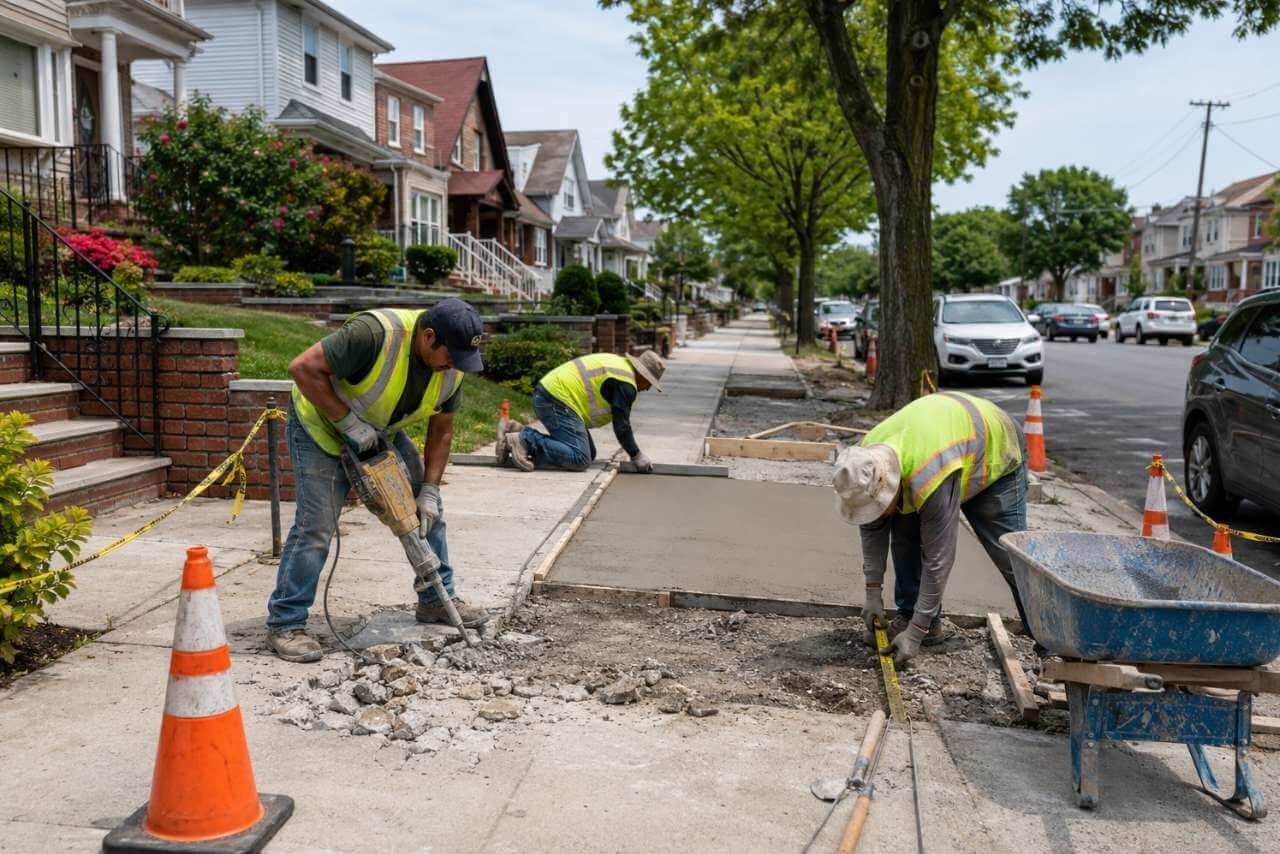
This requirement matters on both small and large projects. Pedestrians still need a clear route while concrete is removed, sidewalk flags are replaced, or other construction work is taking place.
A construction barrier should not force people into moving traffic or leave them with no clear way around the work.
Does the 5-Foot Rule Mean the Sidewalk Can Never Close?
Not necessarily.
There are situations in New York City where a section of sidewalk is closed during construction. NYC project notices show examples where sidewalks have been temporarily closed and pedestrians have been directed to another available route.
The difference is that a planned closure is not the same as simply blocking the sidewalk.
NYC has permit and safety requirements for construction that affects public sidewalks. City records also show enforcement in cases where construction work closed a sidewalk without the required DOT authorization.
In practical terms, a contractor should not decide on their own to close the entire sidewalk because it makes the repair easier.
Pedestrian movement has to be considered as part of the work.
What Happens When There Is Not Enough Room on the Sidewalk?
Some sidewalks do not have enough width to keep a 5-foot path open while repairs are underway.
In that situation, NYC’s rule allows the pedestrian walkway to be moved into a protected pathway on the street.
That does not mean pedestrians should simply walk around cones and into traffic.
The temporary route needs to separate pedestrians from the active work area and street traffic. The exact setup can depend on the location, street conditions, construction activity, and permit requirements.
This is especially important in busy parts of New York City where sidewalks carry steady pedestrian traffic throughout the day.
Why Does NYC Require Pedestrian Access During Sidewalk Repairs?
Sidewalks are part of New York City’s transportation network.
People use them to reach homes, stores, schools, workplaces, subway stations, bus stops, and other destinations. NYC DOT describes the city’s sidewalks and street crossings as an interconnected pedestrian network.
Closing a sidewalk without a safe alternative can create a new hazard while trying to repair an existing one.
A pedestrian may have to step into traffic. Someone using a wheelchair may have no practical way around the work. Parents with strollers and people with limited mobility may also have difficulty using an unsafe or narrow route.
Keeping a clear path is therefore not only about convenience. It is part of managing the construction area safely.
Can Barriers Take Up the Entire Sidewalk?
Construction barriers can separate pedestrians from an active repair area. They should not be placed in a way that leaves pedestrians without the required access.
NYC specifically allows people to report sidewalks blocked by construction equipment, barriers, or construction activity.
The same applies to equipment or materials left in the pedestrian path.
A barrier may be necessary for safety. The placement of that barrier still has to account for how people will move past the site.
Are Permits Required for Sidewalk Repair Work?
Work that affects a New York City sidewalk can require authorization from NYC DOT.
NYC311 states that a contractor completing sidewalk work covered by its sidewalk construction permit requirements must obtain the appropriate permit before work begins. NYC DOT also oversees permits for construction affecting city streets and sidewalks.
Permit requirements matter because sidewalk work affects public space.
Repairing the sidewalk is only one part of the overall work. The construction area also has to be managed properly while the sidewalk is open, restricted, or temporarily unavailable.
Property owners should make sure permit requirements are understood before work starts rather than after the sidewalk has already been opened.
How Can You Tell Whether Sidewalk Work Is Permitted?
NYC provides a way to check active street and sidewalk construction permits.
NYC311 provides details about active permits, including the locations where work is currently authorized.
This can be useful if construction is taking place outside a property and the sidewalk appears to be improperly blocked.
Keep in mind that seeing construction does not automatically mean there is a problem. A temporary restriction may be part of an approved work setup.
The concern is when the sidewalk is blocked without proper pedestrian access or when work appears to be taking place without the required authorization.
What Should You Do If Construction Blocks the Sidewalk?
If construction equipment, barriers, debris, or active work is blocking pedestrian traffic, the condition can be reported through NYC311.
Before reporting it, look at how the site is arranged.
Check whether a clear pedestrian route remains open. Look for a protected temporary walkway. Also check for signs directing pedestrians around a temporary closure.
If no safe route is provided and pedestrians are being forced into an unsafe area, the condition may need attention.
NYC311 also accepts reports involving construction materials or dumpsters that block sidewalks, crosswalks, streets, or other pedestrian areas.
What Property Owners Should Consider Before Sidewalk Repairs
Sidewalk repair planning should go beyond choosing the concrete and scheduling the contractor.
Think about the space around the work area first.
How wide is the sidewalk?
Can a 5-foot pedestrian route remain open?
Will barriers reduce the available walking space?
Will the work extend across the full width?
Does the planned setup affect the curb or street?
What permits are needed?
Answering those questions early can prevent a repair project from creating unnecessary problems for pedestrians.
It can also help make sure the contractor’s work area fits the conditions of the location.
The Bottom Line
Can a sidewalk be fully closed during repairs in NYC? Yes, a sidewalk may be temporarily closed in certain construction situations. But a contractor cannot simply block pedestrian access without addressing how people will safely get around the work.
For sidewalk construction sites, NYC requires a minimum 5-foot pedestrian walkway on the sidewalk or in a protected pathway on the street.
Where an approved project requires a sidewalk closure, another pedestrian route or detour may be used. Proper permits and site controls also matter.
For property owners, the safest approach is to plan pedestrian access at the same time as the sidewalk repair itself.
For pedestrians, a construction site should provide a clear way to understand where to walk. If construction blocks the sidewalk without safe access, the condition can be reported to NYC311.